
Recurring Work Items
Some tasks happen on a regular cadence — daily standups, weekly reviews, monthly reports, quarterly audits. Instead of manually creating these items every time, SetGet lets you define a recurrence rule on a work item so that new instances are created automatically on schedule.
How recurring work items work
A recurring work item has a recurrence rule attached to it. When the scheduled time arrives, SetGet automatically creates a new work item with the same properties as the original — title, description, priority, labels, assignees, and other metadata. Each generated instance is an independent work item with its own identifier, activity feed, and lifecycle.
The recurrence system works as follows:
- You create a work item and configure a recurrence rule.
- SetGet records the rule and schedules the next occurrence.
- When the next occurrence date arrives, a new work item is created automatically.
- The new item inherits the properties from the recurrence template.
- The cycle repeats until you pause or delete the recurrence.
Set up recurrence on a work item
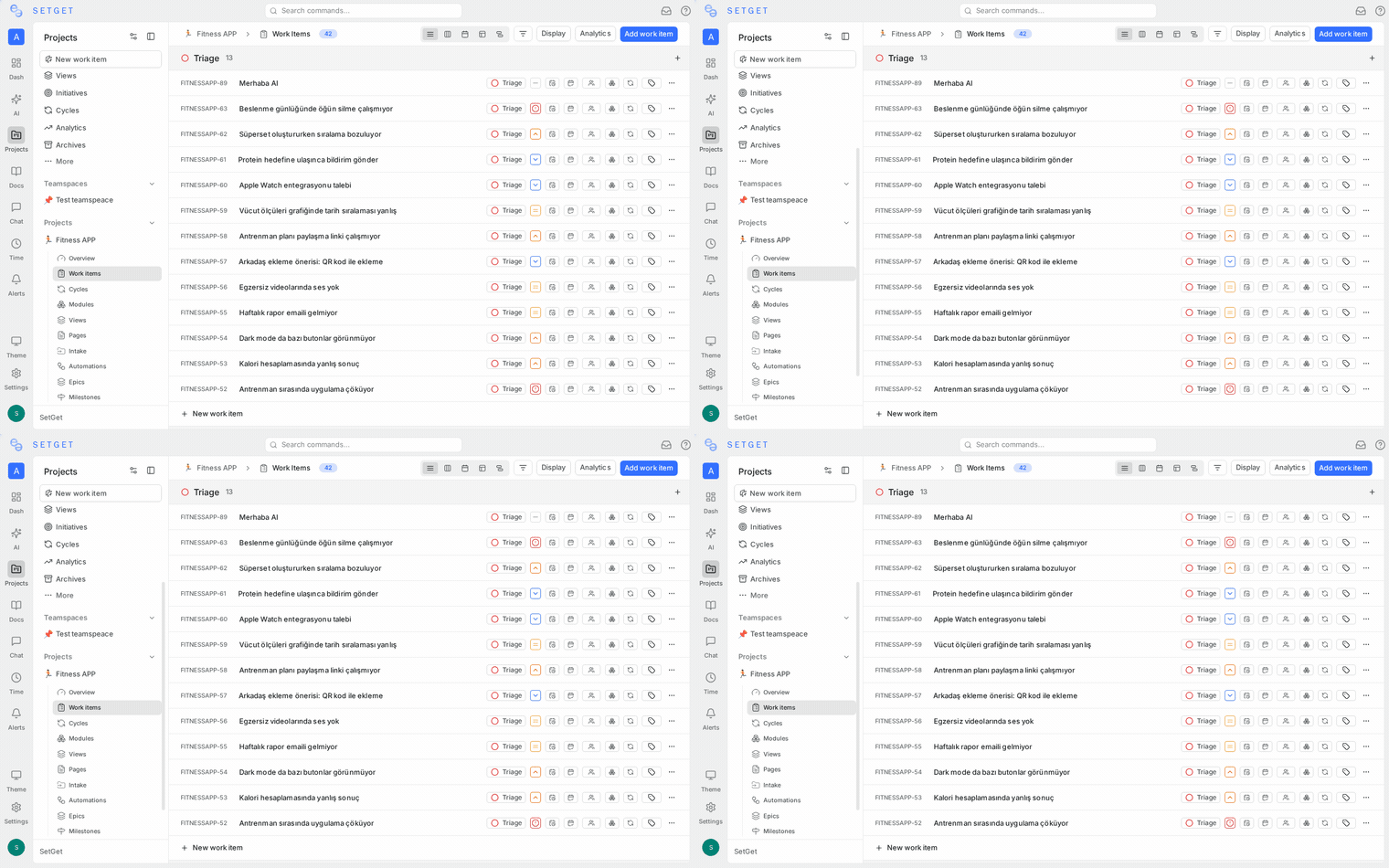
- Open an existing work item or create a new one.
- In the properties panel, find the Recurrence option.
- Click Set Recurrence to open the recurrence configuration dialog.
- Choose a frequency and configure the details (see table below).
- Click Save.
The recurrence icon appears on the work item, indicating that it is a recurring item.
Frequency options
| Frequency | Description | Configuration |
|---|---|---|
| Daily | A new item is created every day | Choose which days of the week (e.g., weekdays only) |
| Weekly | A new item is created every week | Choose the day of the week (e.g., every Monday) |
| Biweekly | A new item is created every two weeks | Choose the day of the week |
| Monthly | A new item is created once per month | Choose the day of the month (e.g., 1st, 15th) or a relative day (e.g., first Monday) |
| Custom | A new item is created at a custom interval | Set a number and unit (e.g., every 3 days, every 6 weeks) |
Recurrence rule details
When configuring recurrence, you can set the following options:
| Option | Description |
|---|---|
| Frequency | How often the item repeats (daily, weekly, biweekly, monthly, custom) |
| Interval | The number of frequency units between occurrences (e.g., every 2 weeks) |
| Day of week | For weekly and biweekly, which day the item is created |
| Day of month | For monthly, which date or relative day (first Monday, last Friday) |
| Start date | When the first recurrence begins (defaults to today) |
| End date | Optional date after which no new items are created |
| End after N occurrences | Optional limit on the total number of items to create |
TIP
If you set both an end date and an occurrence limit, whichever is reached first will stop the recurrence.
What the generated item inherits
Each automatically created work item copies the following from the recurrence template:
| Property | Inherited | Notes |
|---|---|---|
| Title | Yes | Copied exactly; you can include a date token like {date} for dynamic titles |
| Description | Yes | Full rich text content is copied |
| Priority | Yes | |
| Labels | Yes | |
| Assignees | Yes | All assignees are carried over |
| State | Reset | New items always start in the project's default state (typically Backlog or Todo) |
| Due date | Calculated | Set relative to the creation date if a duration was specified |
| Start date | Calculated | Set relative to the creation date |
| Estimate | Yes | |
| Cycle | No | Generated items are not auto-assigned to a cycle |
| Module | Optional | Carried over if configured in the recurrence rule |
| Parent | No | Each instance is independent |
WARNING
Generated items start in the project's default state regardless of the template item's current state. This ensures new instances begin fresh rather than inheriting a completed or cancelled status.
Manage recurring items
View all recurring items
To see which items in your project have recurrence rules:
- Open the project's work items list.
- Use filters to find items with the Recurring property set.
- Recurring items display a recurrence icon next to their title.
Alternatively, look for the recurrence indicator in the work item detail view under the properties panel.
Edit a recurrence rule
- Open the recurring work item.
- Click the recurrence icon or the recurrence details in the properties panel.
- Modify the frequency, interval, days, start date, or end conditions.
- Click Save.
Changes to the recurrence rule affect only future generated items. Items that were already created are not modified.
View generated instances
Each recurring work item has a Generated Items section in its detail view that lists all instances that have been created so far. Click any instance to open it.
Pause and resume recurrence
If you need to temporarily stop a recurrence without deleting the rule:
- Open the recurring work item.
- Click the recurrence icon in the properties panel.
- Click Pause Recurrence.
- The recurrence is suspended. No new items will be created until you resume.
To resume:
- Open the same work item.
- Click the recurrence icon (now showing a paused state).
- Click Resume Recurrence.
- SetGet recalculates the next occurrence date from today and resumes generating items.
TIP
Pausing is useful during holidays, team off-sites, or when a recurring process is under review. It avoids creating items that no one will act on.
Delete a recurrence rule
To permanently stop recurrence:
- Open the recurring work item.
- Click the recurrence icon in the properties panel.
- Click Remove Recurrence.
- The recurrence rule is deleted. The work item itself remains as a normal work item.
Previously generated instances are not affected. They continue to exist as independent work items.
Use cases
| Use case | Frequency | Example |
|---|---|---|
| Daily standup tasks | Daily (weekdays) | "Post standup update" created every Monday through Friday |
| Weekly team review | Weekly | "Prepare sprint review notes" created every Friday |
| Biweekly retrospective | Biweekly | "Facilitate team retrospective" created every other Wednesday |
| Monthly report | Monthly | "Generate monthly metrics report" created on the 1st |
| Quarterly compliance audit | Custom (every 3 months) | "Complete SOC 2 checklist" created on the first Monday of each quarter |
| Release checklist | Custom (every 2 weeks) | "Run pre-release smoke tests" created every other Thursday |
Best practices
- Keep recurring item titles clear — Include the cadence in the title if helpful, e.g., "Weekly: Review open PRs" so the purpose is obvious in lists.
- Assign owners upfront — Recurring items should have assignees from the start so generated instances land in someone's queue automatically.
- Set reasonable due dates — Use relative due dates (e.g., 2 days after creation) so each instance has its own deadline.
- Review and close generated items — Do not let generated items pile up. If recurring items are consistently ignored, reconsider whether the recurrence is needed.
- Pause during quiet periods — Avoid generating items during holidays or team breaks when no one will act on them.
- Use end conditions — For time-bound projects, set an end date or occurrence limit so the recurrence does not continue indefinitely.
Related pages
- Work Item Overview — Create, track, and manage work items
- Templates — Reusable templates for common work item patterns
- Cycles — Time-boxed planning iterations
- Work Item Properties — Complete property reference
- Subscriptions — Notification behavior for new items